
Every sport has been transformed by audio, except swimming. Runners get voice-coached pacing. Cyclists follow structured app workouts. Weightlifters' time sets with audio cues. The moment a swimmer pushes off the wall, that connection disappears. That's finally starting to change with swim workouts.
Why Audio Matters in Competitive Swim Training
The Isolation Problem in Swimming
Push off the wall, and you're alone. No coach's voice, no training partner to pace against, just water, your breath, and the black line. For competitive swimmers, that isolation is both a motivational and a technical problem. A swimmer reinforcing a faulty catch has no way of knowing it mid-length. Their coach sees it from the deck but has no way to communicate it until the rep is already over.
Why Swimmers Train Without Real-Time Feedback
The reason is physics. Bluetooth operates at a frequency that water absorbs almost completely; a signal that travels 30 feet through air travels zero feet through water. It's not a hardware problem that better headphones can solve. Overcoming it requires a different transmission technology, one that uses frequencies capable of penetrating water. Until that existed in a consumer product, swimmers had no choice but to train in silence.
How Audio Changes Focus, Motivation, and Consistency
Research published in the Journal of Strength and Conditioning Research found that swimmers listening to music during time trials performed measurably better than those who didn't. Music reduces perceived exertion, increases stroke rate, and keeps athletes in the water longer. For competitive swimmers, the practical gains come down to three things: better focus during long sets, higher motivation during hard efforts, and more consistent attendance when training feels less like isolation.

Why Swimming Has Always Been the Hardest Sport to Train With Audio
The Wall Feedback Problem: Why Late Corrections Slow Improvement
Motor learning research is clear: feedback is most effective when it arrives immediately after or during the movement being corrected. In swimming, that's impossible with traditional coaching. By the time a swimmer hears "drop your elbow on the catch," they've reinforced the wrong pattern for an entire rep. Multiply that across a full practice and a full season, and the cumulative cost of delayed feedback is significant.
Why Standard Bluetooth Headphones Fail in the Pool
Bluetooth wasn't designed to travel through water, and no amount of engineering changes that. Every swimming headphone that predates live-streaming technology relies on pre-loaded MP3 files because there's no live signal to receive. That means no podcasts, no coaching, no real-time app workouts, just whatever you uploaded before you got in. For competitive swimmers who need more than background music, that's a meaningful limitation.
Traditional Swim Training vs. Audio-Assisted Swim Training
The difference between training with and without audio touches nearly every part of a session.

The shift isn't about making swimming easier; it's about giving swimmers the same connected training environment that every other endurance sport has had for years.

Real-Time Audio Coaching: The Biggest Shift in Competitive Swim Training Technology
Live audio coaching underwater is a category shift, not a feature upgrade. For the first time, coaches can reach swimmers while they're actually in the water, not after.
How Underwater Coach Communication Systems Work
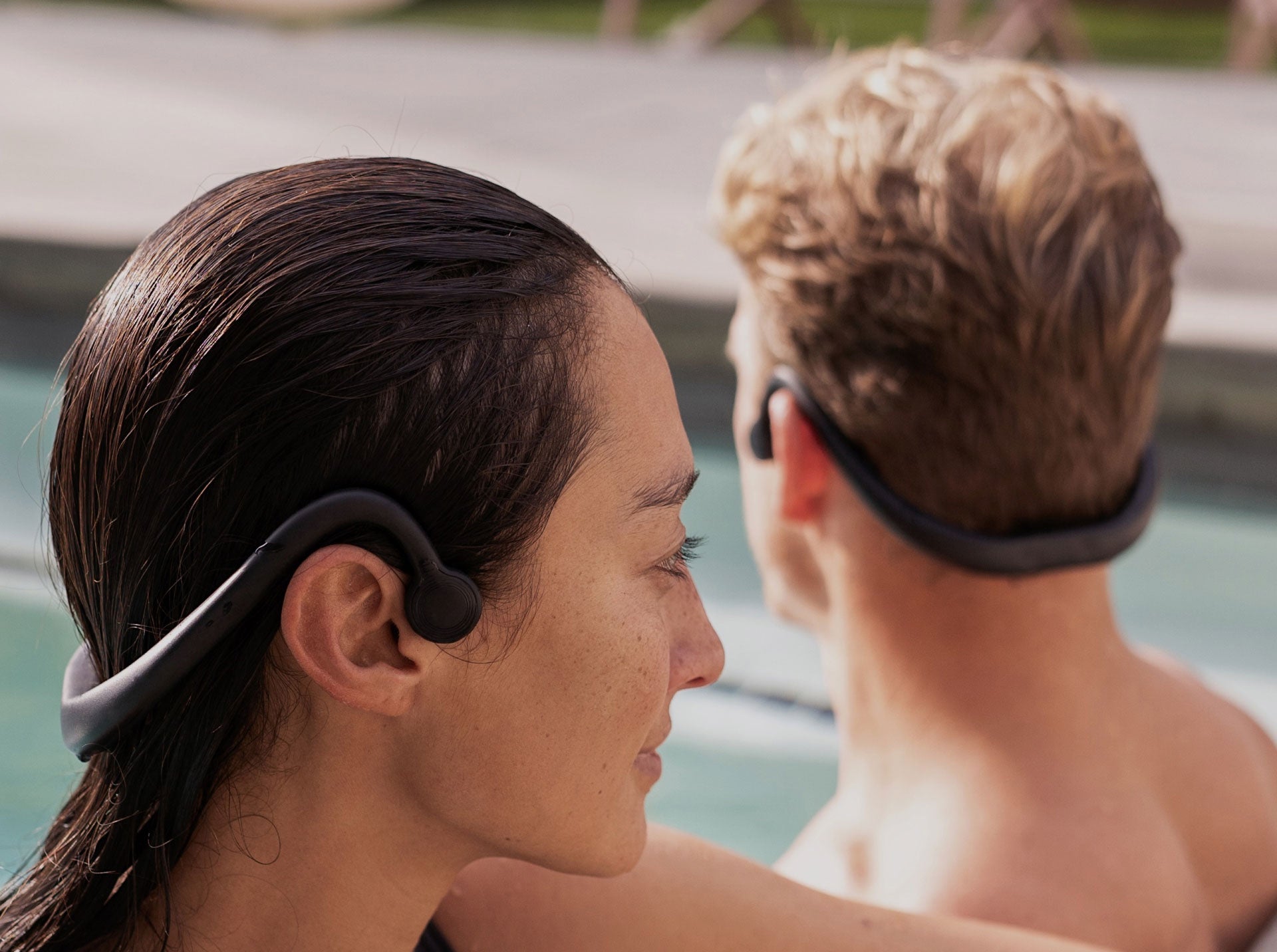
Zygo's system uses a poolside transmitter that broadcasts a radio-frequency signal through the water. Swimmers wear a bone conduction headset that receives the signal continuously, even when fully submerged. The transmitter doubles as a push-to-talk walkie-talkie, so coaching is live, two-way, and available for every length of every set.
Mid-Lap Corrections vs. Wall Feedback: Why Timing Changes Everything
When a coach says "bend your elbow at entry" at the 20-meter mark of a rep, the swimmer adjusts and feels the correct movement in the same length. That's motor learning happening in real time. The same correction at the wall means the rep is over, the wrong pattern has been reinforced again, and the adjustment window has closed.
Group Coaching With Live Audio: Training an Entire Lane Simultaneously
One Zygo transmitter connects to up to ten headsets simultaneously. A coach can address the full lane, a single swimmer, or switch between groups without stopping the set or raising their voice. For club teams and masters programs, every athlete in the water is reachable at any point in the session.
Beyond Coaching: How the Zygo App Turns Your Headset Into a Full Swim Training System
Audio-Guided Swim Workouts: Structured Training Without a Coach in the Water
The Zygo app includes 500+ guided workouts delivered as live audio through the headset, intervals, drills, and threshold sets with cues for rest periods, intensity changes, and stroke reminders. For swimmers who train solo, this replaces the structure that most athletes only get with a coach on deck.
Automatic Lap Counting and Tempo Training: The Data Layer of Audio Swim Tech
A built-in accelerometer tracks laps automatically throughout each session, removing the mental overhead of manual counting mid-set. The tempo trainer helps calibrate stroke rate to a target cadence. Together, these tools add a lightweight data layer to every swim without requiring a separate wearable.
Who Benefits Most From Audio Swim Training Technology
Competitive Club Swimmers
Real-time coaching feedback and structured audio sets address the specific demands of high-frequency training, where small technical gains compound quickly across a season.
Masters Swimmers
Audio reduces perceived exertion during hard sets and makes solo training more sustainable, keeping athletes in the sport longer by making the pool somewhere they want to be.
Triathletes
Triathletes already train with audio on the bike and run. Zygo closes the gap in the water, and the live coaching feature is particularly useful for tri squads where a coach is managing athletes across multiple disciplines.
Self-Coached Swimmers
For swimmers without regular coaching access, the Zygo app functions as a guided training partner, providing the structure, cues, and lap data that most athletes only get with a coach present.
What to Look for in Swim Training Audio Technology in 2026
Live Streaming vs. MP3 Storage: The Key Distinction in Modern Swim Headphones
MP3 headphones require pre-loaded content and can't stream, coach, or adapt in real time. Live-streaming headphones like Zygo Z2 play whatever is on your phone, any app, any content, switchable mid-swim. For competitive swimmers, this is the most important distinction in the category.
Coaching Capability: Why Two-Way Audio Is the Next Frontier in Swim Training Headphones
Music playback is table stakes. The real performance edge comes from two-way communication, a coach who can reach a swimmer mid-length, correct a movement pattern in real time, and guide a full lane without interrupting the set. No MP3 headphone can do this. It requires live RF transmission, a push-to-talk interface, and a headset capable of delivering clear voice audio through bone conduction underwater. Zygo Z2 is currently the only consumer product that delivers all of it.
The tools to train smarter in the water exist now. The question is whether you're using them.