
The Swimmer's Recovery Routine: What to Do Before and After Every Swim
Most swimmers can tell you their 100 splits to the tenth of a second. Ask them about their recovery routine, and you'll usually get a blank look.
It makes sense; the swim is the part that feels like training. Recovery is invisible. But it's also the part that decides whether you can swim four times a week without your shoulders flaring up, or whether you burn out and quietly stop going. Swimming is one of the most repetitive sports there is: a single hour in the pool means thousands of overhead shoulder rotations, over and over, through the same range of motion. That volume is exactly why muscle recovery for swimmers matters more than it does for almost any other kind of workout.
This guide covers the full routine, what to do before you get in, how consistency itself works as recovery, and the post-swim muscle recovery that keeps your shoulders healthy. None of it is complicated. Most of it takes ten minutes.

Recovery Is the Half of Swim Training Most People Skip
Here's the pattern: you push through a hard set, hit your intervals, climb out, towel off, and leave. The training stimulus happened. But the adaptation, the part where your body actually gets stronger and more durable, happens afterward, and only if you give it what it needs.
Skip that half often enough, and it shows up in predictable places. The shoulders first, because they take the brunt of every stroke. Then the upper back and neck, which tighten from the constant reaching and rotating. Left unmanaged, that low-grade overuse is how a lot of swimmers slide into swimmer's shoulder, the irritation and impingement around the rotator cuff that's the single most common complaint in the sport.
The point of recovery isn't to feel pampered. It's to protect your ability to keep swimming. Consistency, not any single heroic session, is what builds fitness, and recovery is what makes consistency physically possible.
Before the Swim: Prime the Body (Don't Just Dive In)
Recovery starts before your first lap. Walking onto the deck cold and launching into a hard set is how strains happen, and it makes the whole session feel worse than it needs to.
A short dynamic warm-up on deck, five to ten minutes, is enough to change the quality of everything that follows:
-
Arm circles and band pull-aparts to wake up the shoulders and upper back
-
Thoracic rotations to loosen the mid-spine that swimming demands so much of
-
Leg swings and hip openers for the kick
The goal is blood flow and range of motion, not a workout. Some swimmers add a minute or two of light massage before getting in, the idea Rally calls "precovery," using gentle stimulation to prime muscles and circulation before load rather than only chasing soreness afterward. It's the same tool doing double duty; more on that below.
Then ease into the water with an easy 200–400, building gradually. Your first hard effort should not be your first effort.
During the Swim: Consistency Is Recovery's Quiet Ingredient
This is the part people don't think of as recovery, but it might be the most important.
Your body adapts best to regular, moderate aerobic work, not to occasional all-out sessions separated by long gaps. Easy swims between your hard days (true active recovery swimming) actually speed recovery by moving blood through tired muscles without adding real stress. A sustainable rhythm of showing up beats a punishing session you need a week to recover from.
Which means the real enemy of recovery is anything that makes you skip. And for a huge number of swimmers, that thing is boredom. The pool is quiet, it's repetitive, and it asks you to stare at a black line for an hour. When a swim feels like a chore, you find reasons not to go, and the consistency that drives adaptation falls apart.
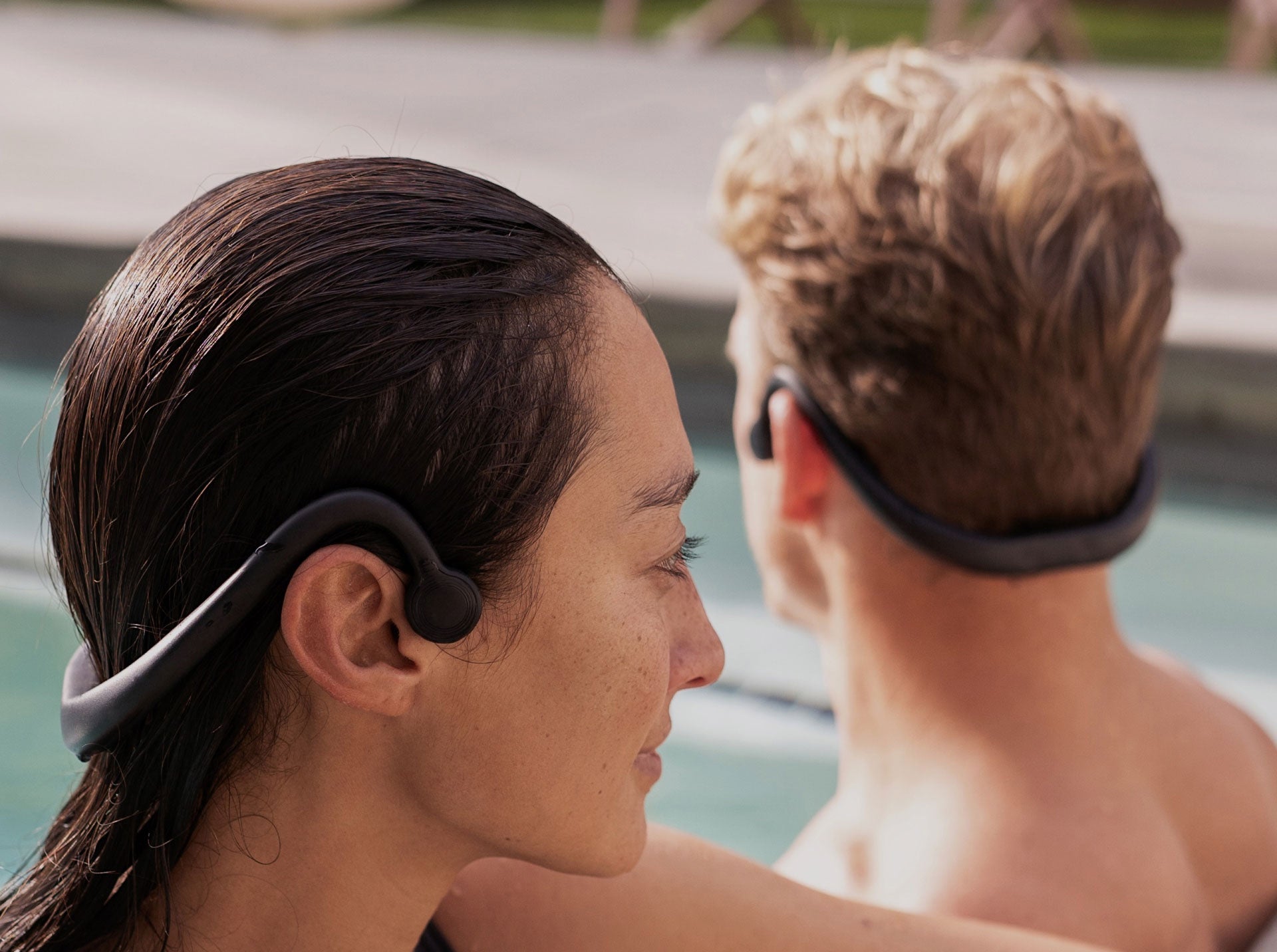
This is where audio changes the math. Being able to stream music, a podcast, or a coaching session while you swim turns dead pool time into time you look forward to, and the swimmers who look forward to it are the ones who keep showing up. (Zygo's whole reason for existing is making that possible, live, underwater, from any app. If you want the science on why it works, see Why Music Improves Swim Endurance and our guide to listening to podcasts while swimming.)
Consistency isn't a mindset problem. It's usually a boredom problem, and that one's solvable.

After the Swim: Muscle Recovery That Protects Your Shoulders
This is the core of any real recovery routine, because this is where you protect the joints swimming works hardest.
The overuse zones are predictable: the shoulders (rotator cuff and deltoids), the lats, the upper back and traps, the neck, and the chest, which tightens from the constant forward reach. Left unaddressed, tight pecs and overworked shoulders pull the joint out of good position, which is the mechanical setup for swimmer's shoulder. Post-swim care is how you interrupt that cycle.
Cool down in the water. Two to three hundred easy meters at the end flushes the muscles and starts recovery before you're even out.
Stretch the reaching muscles. Post-swim is the right time for static stretching, when muscles are warm. Focus on a doorway pec stretch, a cross-body shoulder stretch, and a lat stretch. Hold each for 30 seconds and don't force range you don't have.
Foam roll the upper back and lats. A few minutes rolling the thoracic spine and lats release the tissue that gets tight from thousands of pulls.
Use targeted massage on the shoulders. Self-massage tools increase local blood flow and can meaningfully reduce next-day soreness. But the shoulder is the one area where technique matters: it's full of sensitive, joint-adjacent tissue, and hammering it with an aggressive percussive gun can do more harm than good.
This is where the type of tool matters. A percussive massage gun works by rapid punching — a lot of force delivered in short, hard bursts. That's genuinely useful on large, dense muscle like quads and glutes, where you want to drive pressure deep into thick tissue. It's a blunt instrument, and near a joint that's a problem.
An orbital massager works differently: instead of pounding, it glides in a smooth circular motion, spreading pressure across the surface rather than driving it into one point. That makes it a better match for the sensitive, joint-adjacent areas swimmers actually need to treat — the shoulders and neck — where the goal is circulation, not impact. It's also considerably quieter, which matters more than you'd think for something you'll use daily.
For the shoulder and neck specifically, an orbital recovery massager like Rally is a better match than a hard percussive device — the orbital motion works circulation into the area around the rotator cuff without the jarring impact you don't want near a joint you're trying to protect. Use it on the traps, lats, and the muscles around (not directly on) the shoulder joint.
The Forgotten Pieces: Sleep, Hydration, and Rest Days
The routine above handles the muscles. These handle everything else, and they're where most recovery is actually won or lost.
Sleep. This is where the real repair happens. Most muscle recovery and tissue rebuilding occurs during deep sleep, so consistently getting seven to nine hours does more for you than any tool on this list.
Hydration. Swimmers dehydrate without noticing, because you're surrounded by water and you can't feel yourself sweat. You still are. Rehydrate after every session.
Fuel. A mix of protein and carbohydrate within an hour or so of a hard swim gives your muscles what they need to rebuild.
Rest days. Adaptation happens during rest, not during work. Program at least one or two easy or full-rest days a week. If your shoulders ache constantly, that's not toughness to push through; it's a signal to back off before it becomes an injury.
A Sample Weekly Recovery Routine
You don't need to do everything every day. Here's how the pieces fit across a typical week:
-
Monday — Hard swim. Full post-swim routine: cool-down, stretch, shoulder massage.
-
Tuesday — Easy/active recovery swim. Light mobility, hydrate.
-
Wednesday — Hard swim. Full post-swim routine, plus foam roll the upper back.
-
Thursday — Rest. Sleep priority, gentle shoulder massage.
-
Friday — Moderate swim. Emphasize the warm-up, stretch afterward.
-
Saturday — Long swim. Full post-swim routine.
-
Sunday — Rest. Complete rest, sleep, hydration.
Adjust the swim days to your own schedule; the principle is simply that hard days are followed by easy or rest days, and every swim bookends with a warm-up and a proper cool-down.
Swim More Often, Without Breaking Down
Recovery isn't the opposite of training. It's what lets you train again tomorrow, and the day after, without your shoulders forcing you to stop. Build the routine in, warm up before, stay consistent, care for your shoulders after, and protect your sleep, and swimming stops being something you grind through and starts being something you can do for years.
And the easiest way to stay consistent is to actually enjoy the time in the water. The Zygo Z2 streams music, podcasts, and coaching live underwater, so the laps go by faster and you keep coming back, which, in the end, is what recovery is really protecting.
Frequently Asked Questions
How do swimmers recover after a hard session?
Start with an easy in-water cool-down of 200–300 meters, then stretch the shoulders, chest, and lats while muscles are warm. Add targeted massage to the shoulders and upper back, rehydrate, refuel with protein and carbs, and prioritize sleep that night. The combination is what reduces next-day soreness and protects the joints over time.
What is swimmer's shoulder, and how do you prevent it?
Swimmer's shoulder is overuse irritation or impingement around the rotator cuff, caused by the repetitive overhead motion of freestyle and butterfly. It's the most common injury in the sport. You prevent it with good stroke technique, rotator-cuff and scapular strengthening, adequate mobility, sensible training loads, and consistent post-swim recovery for the shoulders and chest.
Should you stretch before or after swimming?
Do a dynamic warm-up before (arm circles, band work, thoracic rotations) to prime the body for movement. Save static stretching for after, when muscles are warm; that's when holding stretches safely improves flexibility. Static stretching cold before a swim offers little benefit and can slightly reduce power.
Are massage guns good for swimmers?
They can help with recovery, but be careful around the shoulders. Percussive guns are excellent on large muscles like quads and glutes, but their intensity can be too much near the sensitive rotator-cuff area. For a swimmer's main problem zones, shoulders and neck, a smoother orbital massager gives you the blood-flow benefit with gentler, more controllable pressure.