
Running has it. Cycling has it. Even the elliptical has it. Every other workout in your routine has had a podcast solution for years, wireless earbuds, a phone clipped to your arm, and you're set.
Swimming hasn't. Until very recently, the pool was the last dead zone in most people's day, 45 minutes or an hour completely cut off from the audio content that makes every other form of exercise fly by.
If you swim three times a week, that's roughly 150 hours a year of silence. Time you could have spent finishing a course, working through a podcast backlog, or just making the experience genuinely enjoyable enough that you actually want to go back.
This guide explains exactly how to listen to podcasts while swimming, why it was impossible before, what changed, how to set it up, and which types of podcasts work best in the water.
Why you couldn't do this before (the Bluetooth problem)
The short answer: physics.
Bluetooth operates at 2.4 GHz, a radio frequency that travels easily through air but is almost completely absorbed by water. The moment your head submerges and your ears go under, a standard Bluetooth connection drops. It doesn't slow down or degrade. It cuts out, instantly and completely.
This is why every swimming headphone on the market, until recently, required you to pre-load music onto the device before you got in the water. MP3 files stored on the headset itself. No live streaming, no podcasts, no changing your mind mid-lap. Whatever you loaded before you jumped in was what you got.
For background music, that's a minor inconvenience. For podcasts, which are long, episodic, and often tied to a specific moment in a news cycle or story, it made the whole thing impractical.
How Zygo makes live podcast streaming underwater possible
Zygo solved the Bluetooth problem by working around it entirely.
Instead of trying to send a Bluetooth signal through water (which doesn't work), the Zygo Z2 uses a patented radio-frequency transmitter that converts your phone's Bluetooth output into a lower-frequency signal capable of traveling through water. The transmitter sits at the edge of the pool, on a bench or the pool deck, near your phone. Your headset, worn in the water, picks up that signal continuously, even when you're fully submerged.
The result: whatever is playing on your phone plays in your ears. Live. No pre-loading, no syncing playlists, no decisions to make before you get in. Open Spotify, open your podcast app, press play, and swim.
The range covers a standard 50-meter Olympic pool at a depth of 2 to 3 feet. Your phone can be up to 30 feet from the transmitter, so it can stay in your bag while the transmitter sits poolside.

Setup in under 5 minutes
-
Charge both units. The headset and transmitter charge together in the carrying case.
-
Pair your phone to the transmitter via Bluetooth, a one-time setup that takes about 60 seconds.
-
Place the transmitter at the pool edge. It doesn't need to be perfectly positioned, anywhere within 30 feet of your phone and near the water works.
-
Put on the headset and open any audio app on your phone.
-
Swim.
That's the entire setup. From unboxing to first swim, most people are in the water within five minutes.
What the audio actually sounds like underwater
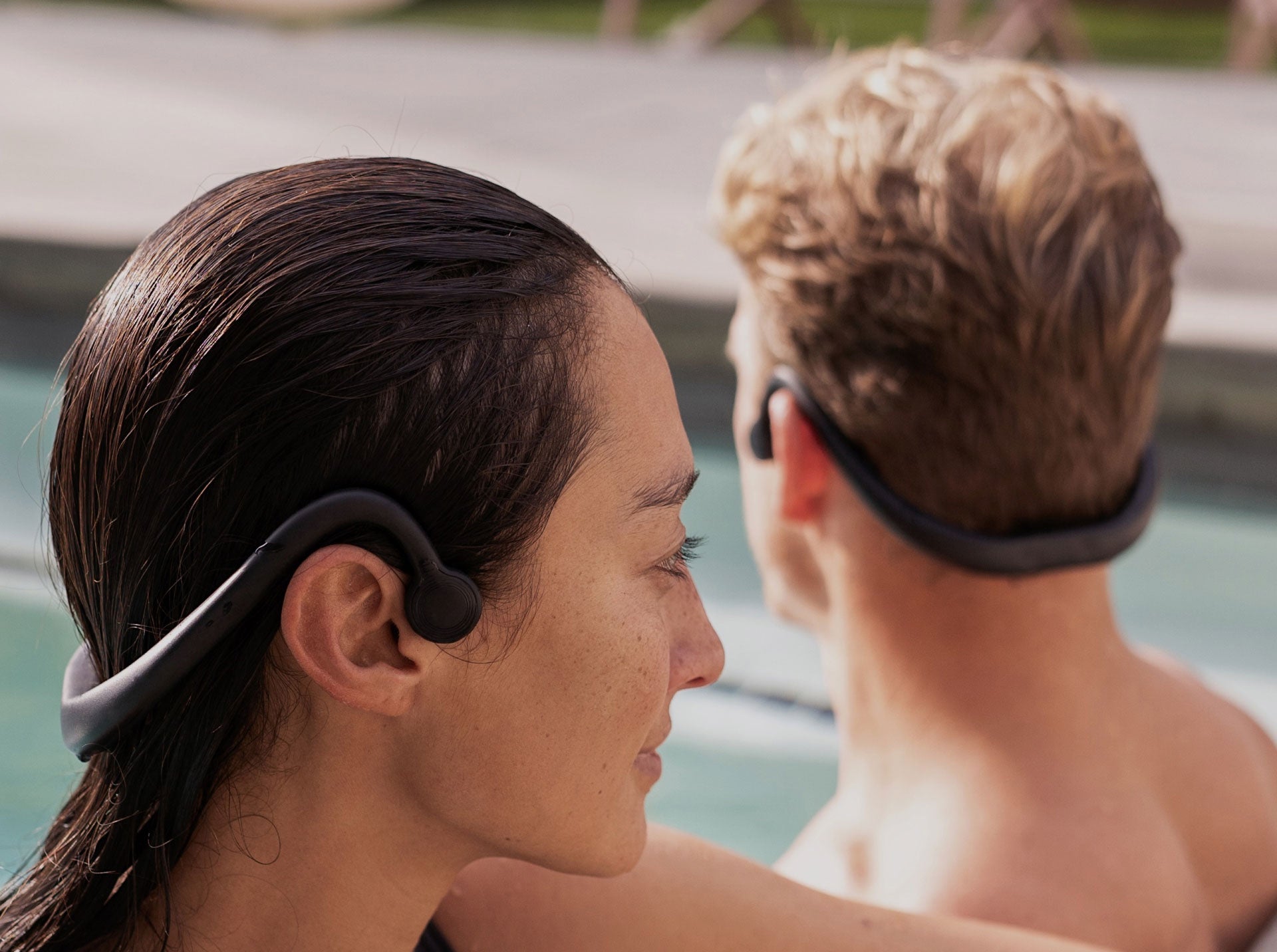
Zygo uses bone conduction technology; the headset rests against your cheekbones rather than sitting inside your ears, and sound travels through your skull directly to your inner ear.
It sounds different from earbuds. There's less bass, and the audio has a slightly open quality to it. For music, some people use the included earplugs to enhance sound quality and fullness. For podcasts, speech, and coaching audio, bone conduction is actually ideal. Voices come through clear and natural, and conversation is easy to follow even when you're mid-lap and breathing hard.
The best types of podcasts to listen to while swimming
Not all podcast formats work equally well in the pool. Here's what to look for, and some recommendations in each category.
News and current affairs (easy, low-focus)
True crime and storytelling (ideal for long sessions)
Education and self-improvement (the productivity swimmer)
Comedy (when you just need to enjoy the swim)
Tips for the best podcast listening experience in the pool
Position the transmitter at pool edge, not in your bag. Signal is strongest when the transmitter is near the water surface and unobstructed. A bench or the pool ledge works perfectly.
Set your volume before getting in. You can adjust volume from buttons on the headset while swimming, but it's easier to set it roughly right beforehand and not think about it again.
Stick with one podcast app. Switching apps mid-session means fishing out your phone, re-pairing, and disrupting your flow. Pick one app for a given swim and stay with it.
Start a new episode at the pool, not at home. If you begin an episode during a commute and swim with the same episode, you're less invested. Save the first play for the water; it makes the pool feel like a destination.
Real swimmers, real results
The technology is genuinely new. The experience it creates isn't abstract; here's how one Zygo swimmer describes it:
"Zygo has changed my life in many ways. I have always enjoyed swimming, and it was a dream to be able to hear music while I swam, but I never assumed I would be able to hear podcasts underwater. Zygo changed that for me, allowing me to take the hour I swim three times a week and convert it to useful time that educates, informs, or enlightens me. Sometimes I just listen to music, but the podcasts, especially with the newer version, are crystal clear and make my time swimming go by quickly. Thank you, Zygo!"
The phrase "convert to useful time" captures something important. It's not just that swimming is more enjoyable with audio; it's that the pool becomes a place where something valuable happens, instead of time you just get through.
Ready to make your swim time count?
Swimming is no longer the workout you do in silence. With Zygo Z2, every lap is an opportunity, to learn something, enjoy a story, or simply make the experience good enough that you come back next week.
Listen to Podcasts Underwater FAQs
Can you listen to podcasts underwater?
Yes, with the right equipment. Standard Bluetooth headphones don't work underwater because the signal can't penetrate water. Zygo Z2 uses a patented radio-frequency transmitter that converts your phone's audio into a signal that travels through water, enabling live podcast streaming while fully submerged.
Do you need special headphones to swim with podcasts?
Yes. Regular headphones and standard Bluetooth earbuds aren't waterproof and can't maintain a signal underwater. Zygo Z2 is specifically designed for underwater use and is currently the only headphone that streams live audio (including podcasts) while swimming.
Does Spotify work underwater with Zygo?
Yes. Because Zygo streams whatever is playing on your phone, any app, Spotify, Apple Podcasts, Overcast, YouTube Music, Audible, works the same way. Open the app, press play, swim.
Is the audio quality good enough for podcasts?
Yes, many users find bone conduction particularly well-suited to spoken word content. Voices come through clear and natural. Using the included earplugs enhances the experience further.