
Not every swimmer has access to a full lap pool—and for many triathletes, that can make consistent training a challenge.
The Challenge of Training Without Lap Lanes
Small community pools, hotel pools, or backyard setups often don’t have the space needed for traditional lap swimming. That’s where many athletes either skip swim workouts altogether or struggle to stay consistent.
But there’s a simple solution that more triathletes are turning to: tethered swimming.
What Is Tethered Swimming (And Why Triathletes Use It)?
Tethered swimming allows you to swim in place by attaching a resistance cord to the pool wall, ladder, or stairs. Think of it like a treadmill—but for swimming.
Instead of turning at the wall every lap, you can swim continuously in one spot, making it a powerful tool for:
-
Building endurance
-
Improving stroke consistency
-
Training in smaller pools
For triathletes, it’s an efficient way to maintain swim fitness even without access to a regulation lane.

The Problem: Why Tethered Swimming Gets Boring Fast
While tethered swimming solves the space problem, it introduces a new one: boredom.
Swimming in place means:
-
No change in scenery
-
No natural lap breaks
-
No sense of forward movement
It can feel repetitive fast—especially during longer endurance sessions. And when workouts feel monotonous, it’s harder to stay consistent.

How Underwater Headphones Transform Swim Training
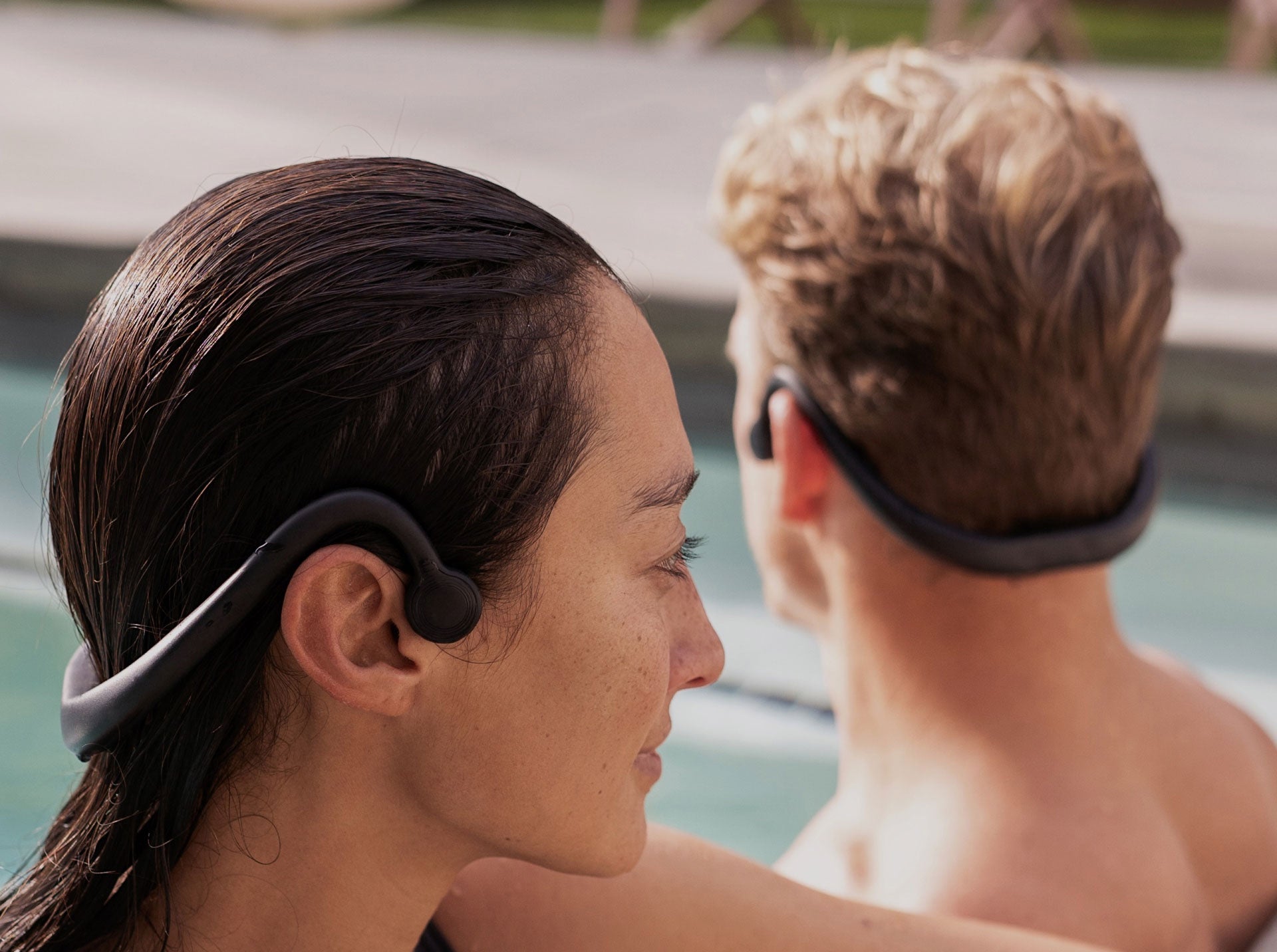
This is where Zygo underwater headphones completely change the experience.
Instead of counting tiles or staring at the same wall, you can:
-
Listen to music, podcasts, or audiobooks
-
Follow guided workouts or coaching
-
Stay mentally engaged for longer sessions
For many swimmers, this turns a boring workout into something they actually look forward to.
Real Swimmer Story: Staying Consistent at 50 with Tethered Training
One triathlete shared how tethered swimming—and Zygo—completely changed their routine:
Training for sprint triathlons, they relied on a small community pool without lap lanes. Their solution? Tethering themselves to the deep-end stairs and swimming continuously.
At first, it felt just like running on a treadmill—effective, but repetitive.
Then they added Zygo.
Suddenly, those same workouts became immersive. Instead of focusing on the monotony, they could turn on an audiobook and get lost in the story—swimming nonstop for 30–40 minutes at a time.
Even better, their daughter could communicate with them from poolside when needed, adding a layer of connection and peace of mind.
At 50 years old, balancing a fitness business and family life, they found a way to stay consistent, stay motivated, and lead by example.
"Training for Sprint Triathlons is my go to activity to stay in shape. I have access to small community pool and it doesn't have lap lanes. So I tether myself to the deep end stairs and go to town! Just like a treadmill for running can get very boring staying in place and looking at the same stuff so does thethered swimming! So my Zygos save the day! My daughter can communicate with me when she has a question so it offers peace of mind too. I love turning on an audiobook and getting lost in the story as I get 30-40 mins of non-stop swimming in. I can't believe I ever swam without them! At 50 years old I need to stay in shape and live by example! I have a 13 year old daughter to keep up with and a thriving fitness business. I love having reliable tools to use and recommend to my clients! The Zygos are an easy tool to recommend! "

Bonus Benefit: Staying Connected While You Swim
One of Zygo’s most unique features is real-time communication.
Unlike traditional waterproof headphones, Zygo allows someone poolside to talk directly to the swimmer through the headset.
This opens up new possibilities:
-
Parents can stay connected with their kids
-
Coaches can give live feedback
-
Swimmers can train with added safety and awareness
For many users, this feature alone sets Zygo apart.
Why Triathletes Should Add Audio to Swim Training
Consistency is everything in triathlon training—and audio can make a bigger difference than you might expect.
Adding underwater audio helps:
-
Reduce boredom during long sessions
-
Increase workout duration and focus
-
Make solo training feel less isolating
-
Build a sustainable routine
When workouts are more enjoyable, they’re easier to stick with—and that’s where real progress happens.
Who This Setup Is Perfect For
This approach is ideal for:
-
Triathletes training without access to lap pools
-
Swimmers using small or shared pools
-
Busy parents balancing workouts and family
-
Fitness professionals looking for tools to recommend to clients
If you’ve ever struggled to stay engaged during swim workouts, this setup can be a game-changer.
Final Thoughts: From Boring to Breakthrough Workouts
Tethered swimming solves the problem of limited space—but adding audio transforms the entire experience.
What used to feel repetitive becomes immersive.
What used to be hard to stick with becomes part of your routine.
For swimmers and triathletes alike, tools like Zygo aren’t just convenient—they’re the difference between skipping workouts and showing up consistently.
FAQs for Tethered Swimming Headphones
Can you do effective swim workouts without lap lanes?
Yes. Tethered swimming allows you to swim in place while still building endurance and maintaining proper form, making it a great option for small pools.
Can you listen to audiobooks while swimming?
Yes, with underwater headphones like Zygo, you can stream audiobooks, music, and podcasts directly while you swim.
Is tethered swimming good for triathlon training?
Absolutely. It allows for continuous swimming, which is ideal for building endurance and preparing for open water conditions.
How do underwater headphones work in a pool?
Zygo uses radio transmission and bone conduction technology to deliver clear audio underwater, unlike Bluetooth, which doesn’t work well in water.